Mesh Tulle Fabric may look weightless, but choosing it well takes careful attention. A soft bridal veil, a gathered stage skirt, and a fine decorative overlay can all require different mesh density, drape, and recovery. Under bright light, tiny differences in yarn, color, or finish become easy to see. Small details matter.
William Morris, the British designer and textile artist, offered a useful design principle: “Have nothing in your houses that you do not know to be useful, or believe to be beautiful.” For buyers, that idea applies to both appearance and performance. A fabric should suit its intended use, not just look attractive in a sample book.
This guide to China’s top 10 Mesh Tulle Fabric manufacturers is intended to help buyers compare potential suppliers, not promise that one factory fits every project. The overview considers product range, customization, production information, communication, and sample evaluation. These details can help narrow a shortlist, but they do not replace direct checks. Request current specifications, inspect physical samples, and confirm lead times before placing an order. A swatch may feel excellent in the hand yet behave differently when gathered or sewn. That is worth remembering. Supplier information can also change, and public claims may not answer every practical question. Treat the ranking as a starting point, ask specific questions, and verify what matters for your design.
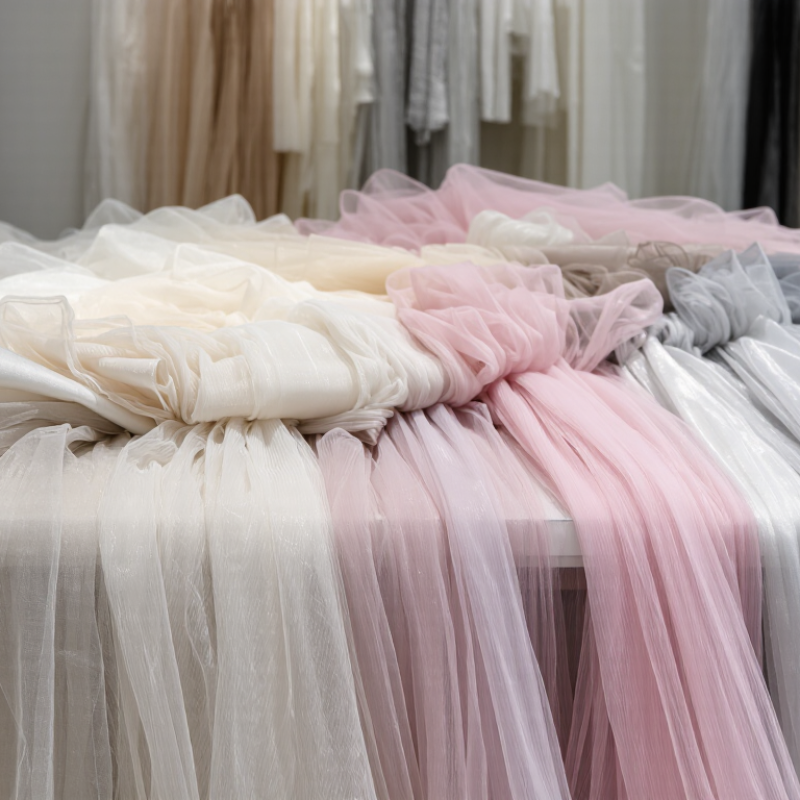
Mesh tulle is not defined by appearance alone. Fiber affects hand feel, stretch, dye response, and durability. Polyester often feels stable and holds its shape well. Nylon, also called polyamide, can feel softer and offer more stretch. Touch a swatch, then gently pull it. The difference may be subtle.
Mesh opening describes the space between yarns, not the size of the finished garment’s holes. A smaller opening can create a denser, less transparent surface. Ask manufacturers how they measure openings, since methods and tolerances can vary. Hold samples against a marked card or a light source. Small details matter.
GSM measures fabric weight per square metre. A higher GSM often means more coverage, but construction and fiber also affect opacity and drape. Yarn denier indicates the mass of yarn: lower denier usually means finer yarn, while higher denier tends to feel more substantial. Compare these figures together when reviewing supplier specifications. A neat spec sheet still cannot show snagging, edge curl, or how fabric behaves after sewing. I have seen two samples with similar GSM feel quite different; specifications need a physical check.
Use these indicative construction examples to compare mesh tulle specifications. They are not a verified manufacturer ranking or a directory. Mesh opening, weight, and usable performance vary with construction, finishing, and measurement method; confirm each specification with a fabric swatch and agreed test method.
| No. | Example construction | Fiber | Approx. clear mesh opening | Indicative GSM | Yarn denier | Typical use | Specification checks |
|---|---|---|---|---|---|---|---|
| 1 | Fine soft bridal tulle | Nylon (polyamide) | About 0.5–1.0 mm | 12–20 g/m² | 15–20D | Veils, overlays, bridal layering | Hand feel, snagging, shade consistency |
| 2 | Fine polyester tulle | Polyester | About 0.6–1.2 mm | 15–25 g/m² | 15–30D | Apparel overlays, decoration | Dimensional stability, colorfastness |
| 3 | Soft volume tulle | Nylon (polyamide) | About 1.0–2.0 mm | 18–30 g/m² | 20–40D | Skirts, petticoats, costume layers | Recovery, volume, abrasion resistance |
| 4 | Standard apparel net tulle | Polyester | About 1.0–2.5 mm | 20–35 g/m² | 30–50D | Garments, craft and event decoration | Opening uniformity, width, finishing |
| 5 | Stretch mesh tulle | Nylon with elastane | About 0.5–1.5 mm | 50–100 g/m² | Nylon 20–40D; elastane specified separately | Dancewear, bodysuits, fitted panels | Stretch and recovery in both directions |
| 6 | Medium-open polyester net | Polyester | About 2.0–4.0 mm | 30–60 g/m² | 50–75D | Costumes, bags, decorative panels | Tear strength, edge stability, aperture size |
| 7 | Firm nylon netting | Nylon (polyamide) | About 2.0–5.0 mm | 35–70 g/m² | 50–100D | Structured accessories, costume support | Tensile strength, stiffness, seam behavior |
| 8 | High-tenacity open mesh | Polyester | About 3.0–6.0 mm | 45–90 g/m² | 75–150D | Utility panels, sturdy bags, sports accessories | Load requirements, tear resistance, coating if applicable |
| 9 | Flame-retardant polyester mesh | Flame-retardant polyester | About 1.0–4.0 mm | 40–100 g/m² | 50–150D | Stage, exhibition, and interior applications | Required flame test, certificate, and end-use compliance |
| 10 | Coated or finished polyester mesh | Polyester, with finish as specified | About 1.0–5.0 mm | 50–120 g/m² | 75–150D | Decorative, protective, or application-specific panels | Finish type, adhesion, airflow, wash or weather performance |
Denier (D) is a linear-density unit for yarn: the mass in grams of 9,000 metres of yarn. GSM means grams per square metre. Mesh opening is shown as an approximate clear aperture; the measured value depends on fabric structure and the measurement method. For elastane-containing fabrics, request the elastane content and yarn specification separately.
Zhejiang has dense knitting, dyeing, and finishing networks. Jiangsu is worth checking for warp-knit meshes. Guangdong may support quick sampling, while Fujian has stretch-fabric experience. These are patterns, not guarantees.
Ask for mesh count, usable width, weight tolerance, colorfastness results, and fiber blend. Check whether the fabric is soft bridal tulle, stiff netting, stretch mesh, or lining. Small details matter.
No. Request a production sample tied to the intended specifications. A small swatch may miss coating or shade variation across a full roll. I would not trust a neat catalog alone.
ISO 13934-1 measures maximum force and elongation. Request results in both fabric directions. ISO 105-C06 evaluates colorfastness to washing under stated conditions. There is no universal pass score for every use.
Match the report to the exact fiber blend, finish, color, and weight. Confirm the lab tested conditioned samples. The sample should also represent the production lot. Still, this can be missed.
Request separate minimums for stock colors, custom dyeing, and printed or coated mesh. Ask whether sampling counts toward the order. Get separate timelines for sampling, production, inspection, and shipping.
Request current certificates and check their scope. Ask for test reports suited to your product requirements. A certificate alone is not a full audit. That is easy to overlook.
Ask who prepares packing lists, invoices, carton marks, and shipment updates. Request recent on-time delivery data. Confirm production start dates in writing, after deposit and color approval. Bulk rolls can still vary.
This article provides a practical guide to evaluating China’s Mesh Tulle Fabric manufacturers. It explains how fiber composition, mesh opening, fabric weight in GSM, and yarn denier affect appearance, durability, and suitability for different applications. It also outlines how manufacturers across China may differ in product range, production capabilities, and regional strengths, helping buyers identify suppliers that match their requirements.
The guide compares key factory specifications, including weight, usable width, and custom finishing options, and describes ways to assess quality through tensile-strength testing under ISO 13934-1 and colorfastness testing under ISO 105-C06. Buyers can also use the article’s checklist to compare minimum order quantities, production lead times, compliance documentation, and export support before requesting samples or placing an order.

 WEIJIN TEXTILE